In June 2026, during the International Confederation of Midwives (ICM) Congress held in Lisbon, a decision sparked a debate that extends far beyond the field of midwifery.
The ICM temporarily suspended its Position Statement on Partnership Between Indigenous and Non-Indigenous Midwives, a document published in 2021 that recognized the value of collaboration between Indigenous midwives and midwives educated through academic systems. According to the organization, the suspension will allow the statement to be revised so that it aligns with the International Definition of the Midwife. However, many Indigenous organizations have viewed this decision as a step backward and the loss of one of the few official recognitions of their role within the international midwifery community.
Beyond the differing perspectives, this situation invites us to ask a broader question: Who decides which knowledge is valuable? It is a question that concerns not only midwifery but also the way we build healthcare systems, the relationship between science and tradition, and the value we assign to knowledge that develops outside academic institutions.
Birth Existed Long Before Hospitals
For most of human history, birth took place without hospitals, fetal monitors, or universities. Women were supported by other women who learned through observing hundreds of births, receiving teachings passed down through generations, and developing their knowledge through years of experience. This was knowledge built through observation, practice, and deep relationships within the community, rather than through textbooks or formal education.
Today, in many parts of the world, Indigenous midwives continue to fulfill this role. They support pregnancy, birth, postpartum, and breastfeeding, drawing not only on an understanding of birth physiology but also on an intimate knowledge of the language, culture, and social context of the families they serve. The fact that this knowledge was not acquired within a university does not, in itself, make it less valuable.
Tradition and Modern Medicine Are Not Opposites
When discussing this topic, it is easy to fall into one of two extremes. On one side are those who dismiss all traditional practices as outdated and incompatible with modern medicine. On the other hand are those who romanticize every aspect of Indigenous knowledge simply because it is ancient. Neither perspective does justice to the complexity of the issue.
Modern medicine has dramatically reduced maternal and newborn mortality through scientific research, surgery, antibiotics, blood transfusions, intensive care, and professional education. Denying these achievements would be irresponsible.
At the same time, not every traditional practice deserves to be preserved. Some, such as female genital mutilation, constitute serious violations of human rights. Every practice—whether traditional or modern—should be evaluated based on safety, available evidence, and respect for human dignity.
When Indigenous Midwives Are the Healthcare System
Too often, discussions about Indigenous midwives assume there is a choice between hospital-based care and traditional birth attendants. For millions of women, however, that choice simply does not exist.
In many rural and remote regions of Latin America, Africa, Asia, and Oceania, the nearest health facility may be several hours away, and poor infrastructure can make timely access impossible.
In these settings, Indigenous midwives are not an alternative to the healthcare system—they are the healthcare system available. They are often the first to recognize complications, the trusted figures within their communities, and, when possible, the bridge between families and hospital services. Excluding them without creating meaningful pathways for collaboration risks increasing women's vulnerability rather than improving their safety.
Building Bridges
Perhaps the real question is not whether we should choose between modern medicine and traditional knowledge, but how these two worlds can work together.
Across different countries, there are already examples of successful collaboration: reciprocal training programs, referral systems for obstetric emergencies, and partnerships between professional midwives and traditional birth attendants. Modern medicine provides essential tools for managing complications, while Indigenous midwives offer continuity of care, cultural understanding, and deep knowledge of their communities.
Rather than viewing these approaches as incompatible, we might begin to see them as complementary.
Ultimately, the debate that emerged in Lisbon is about more than one professional group. It challenges us to reflect on the meaning of knowledge itself. We can continue to uphold high professional standards without erasing those who have accompanied birth for generations. We can invest in scientific research without ceasing to listen to the communities we serve.
Perhaps the future of maternity care lies not in choosing between tradition and science, but in building bridges that allow both to work together—respecting safety, women's dignity, and the richness of diverse cultures.
Bibliography
Davis-Floyd, R. (2003). Birth as an American Rite of Passage (2nd ed.). University of California Press.
Davis-Floyd, R., & Sargent, C. F. (Eds.). (1997). Childbirth and Authoritative Knowledge: Cross-Cultural Perspectives. University of California Press.
International Confederation of Midwives. (2021). Position Statement on Partnership Between Indigenous and Non-Indigenous Midwives.
International Confederation of Midwives. (2024). International Definition and Scope of Practice of the Midwife. https://internationalmidwives.org
International Confederation of Midwives. (2026, June 17). Statement on the Temporary Suspension of the Position Statement on Partnership Between Indigenous and Non-Indigenous Midwives.
Jordan, B. (1993). Birth in Four Cultures: A Cross-Cultural Investigation of Childbirth in Yucatan, Holland, Sweden, and the United States (4th ed.). Waveland Press.
United Nations Population Fund. (2021). The State of the World's Midwifery 2021.
World Health Organization. (2018). WHO Recommendations: Intrapartum Care for a Positive Childbirth Experience.
Image Credit
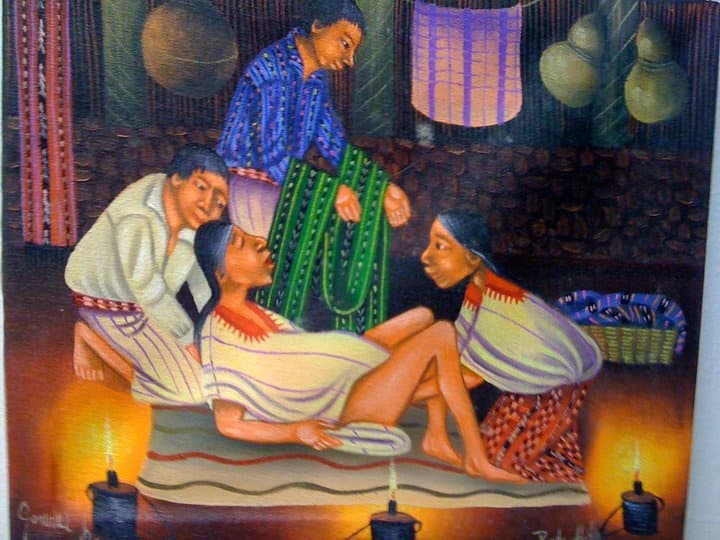
González Chavajay, P. R. (1996). La Comadrona (The Midwife). Oil on canvas, 20 × 28 in. Helen Moran Collection, Artemaya.