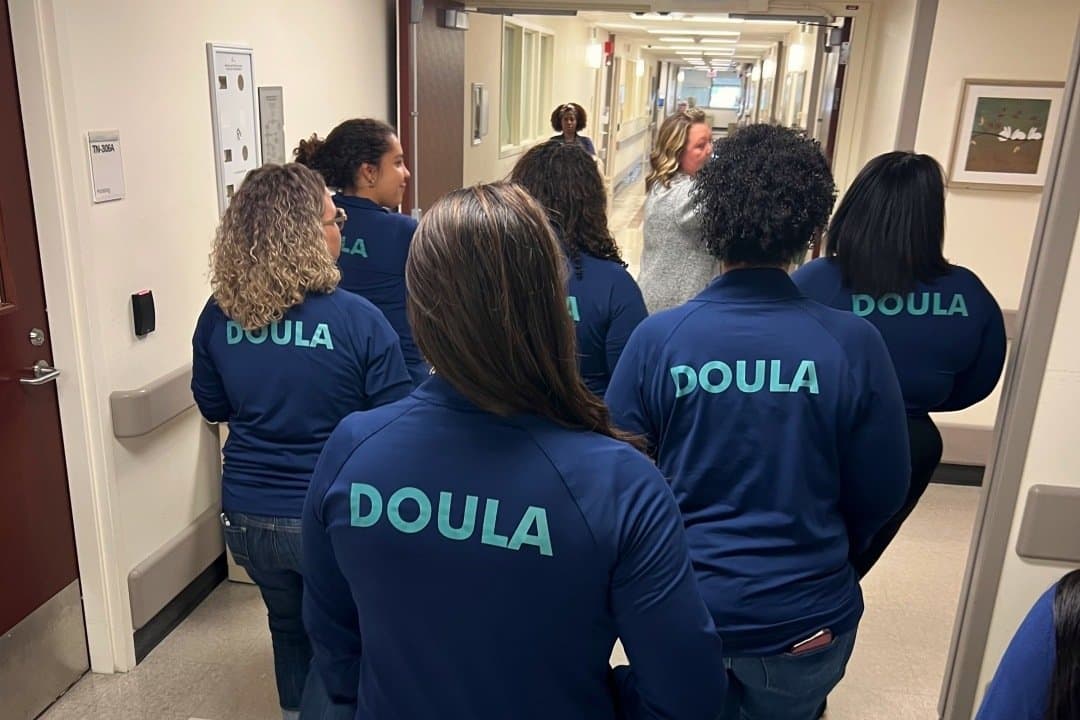
More and more hospitals are bringing doulas into their maternity teams. It is a real step forward for support during birth, but it raises a question: when a hospital doula is paid by the institution, who is she accountable to? In hospital or outside it, a doula is there for the person who chose her.
Recognition raises a difficult question
Something is changing in maternity care. More hospitals and health systems are recognising the value of doulas. Some collaborate with community doulas, others create internal programmes, and some directly employ doulas.
At first glance, this is wonderful news. Doulas have spent years explaining that our role is not opposed to medicine. A doula does not replace a midwife, doctor or nurse. She offers something different: continuous presence, physical and emotional support, information, and support for a woman to participate meaningfully in decisions about her body and birth.
Evidence supports the value of continuous labour support. The Cochrane review by Bohren and colleagues associates it with a greater likelihood of spontaneous vaginal birth, a lower likelihood of caesarean birth and a more positive birth experience. The World Health Organization also recommends that every woman should be able to have a companion of her choice during labour and childbirth. [1, 2]
When the doula becomes part of the institution, who does she work for?
Recognition is an important step forward. It also raises a question our profession should be willing to face.
A particular position
Doulas have always occupied an unusual space in maternity care. We are not medical professionals and do not make clinical decisions. We do not diagnose, prescribe or replace clinical staff. But neither are we simply visitors. We are there because a woman has chosen us.
Historically, this position outside the system has given the role something precious: the doula’s primary responsibility is to the person she supports. Not to a protocol, a statistic or the goal of achieving physiological birth at all costs. And not to her own philosophy of what birth should look like.
DONA International’s Code of Ethics places the individual and family at the centre of perinatal care and connects the doula role with autonomy, informed decision-making and the client’s own values. [3]
Can two responsibilities coexist
When a doula is paid or managed by a hospital, a possible dual responsibility emerges: to the person receiving support and to the employer. This does not mean those loyalties will inevitably conflict. In most situations, they can coexist well.
A woman wants to move during labour? Everyone collaborates. She wants an epidural? Her doula continues supporting her. Birth requires a caesarean? The doula can help the woman and her family navigate that change. Collaboration does not automatically mean conflict.
The tension appears when a woman’s preferences do not fit neatly within institutional routine. What happens when she wants to ask more questions, requests time before deciding when clinically appropriate, declines a procedure or asks about alternatives?
The question is not whether the doula should persuade her to say no. It is whether the doula remains equally free to help her say yes or no.
A doula should have no hidden agenda
A doula should not enter a birth room with the hidden goal of achieving physiological birth. She should not need to prevent a caesarean at all costs or oppose epidural analgesia, induction or medical intervention in principle. But neither should her role become making the woman more compliant with the system around her.
Our job is not to achieve a particular kind of birth. It is to help someone experience her birth with information, presence, dignity and meaningful choice.
If, after receiving information, a woman chooses an epidural, we support her. If she does not want one, we support her. If she chooses induction, we support her. If she wants to ask whether waiting is a reasonable option, we help her formulate the questions. If intervention becomes necessary, we have not failed. And if a woman changes her mind completely from what she wrote in her birth plan, she has not failed either.
A doula is not there to protect the birth plan. She is there to protect the person’s decision-making space.
Doulas need accountability too
It would be naive to ignore the other side of the issue. The profession has grown enormously, while training, certification and regulation vary considerably between countries and organisations. As in any activity involving people during vulnerable moments, inappropriate practice can occur.
A doula can move beyond her scope, give medical advice she is not qualified to give, impose her beliefs, create unnecessary fear of healthcare professionals or present personal opinions as scientific information. She can turn advocacy into antagonism.
We therefore need standards, clear boundaries, education and professional accountability. Organisations such as DONA have developed standards of practice, ethics codes and processes for addressing possible violations. [3, 4]
Accountability and institutional obedience are not the same thing.
The integration paradox
A qualitative study published in 2026 describes an integration paradox. The characteristics that can make doulas valuable, including institutional independence, relationship-based care and an advocacy orientation, can also be difficult to place within a hierarchical healthcare structure. [5]
That does not mean doulas should remain outside hospitals. We need doulas in hospitals and clinicians who know how to collaborate with them. Support should not be a privilege reserved for families who can afford private care. Hospital programmes and public coverage can widen access, particularly for families who might otherwise never receive doula support. [6, 7]
Chicago as an example of a hybrid model
The example we had in mind is in Chicago. UChicago Medicine created a partnership with Partum Health to provide free doula support to eligible patients. The programme’s public fact sheet states that community-based and independent doulas remain welcome and that, when a patient arrives with her own doula, that relationship is respected. [8]
This is not simply a case of a hospital directly employing doulas. It is a hybrid model: the health system expands access through a partner while stating that it will not replace the relationship chosen by the woman. This does not remove every possible tension, but it offers a useful design principle: integrate the service without making the institution the only route to support.
There are also explicitly hospital-based programmes, including the programme launched by Henry Ford Health in Detroit. These models can reduce financial barriers and bring support where it was previously unavailable. Their quality, however, depends on more than the presence of a doula. It depends on mandate, autonomy, supervision, continuity and transparency for the patient. [9]
Integration without assimilation
The future may not require a choice between independent and hospital-based doulas. It may require systems in which both can exist, with transparent roles and clear boundaries.
A woman should know who pays her doula, who the doula is accountable to, the limits of the role and whether potential conflicts of interest exist. She should remain free to bring an independent doula when the hospital offers its own programme. A doula working within the institution should be able to support questions, reasonable pauses for decision-making and informed consent without that being treated as disloyalty.
The final question is not whether the doula followed hospital protocol. Nor is it whether she achieved the birth the woman originally imagined.
Was this woman heard, informed, respected and supported in making her own decisions?
If the answer remains yes, integrating doulas into health systems can be a valuable development in maternity care. But when the priority becomes protecting the institution from the woman’s voice, or protecting the doula’s ideology from the woman’s choices, we lose the meaning of the role.
A doula is not there to serve a system or an ideology. She is there to serve the person who chose her.
Frequently asked questions about hospital doulas
What is the role of a doula in hospital?
Continuous presence, physical and emotional support, and information, so that a woman can take part in the decisions about her own birth. A doula is not a medical professional: she does not diagnose, prescribe or make clinical decisions.
Does a doula replace the midwife or doctor?
No. A doula works alongside the clinical staff, in a different role: she does not replace a midwife, doctor or nurse.
What is the difference between a hospital doula and an independent doula?
A hospital doula is paid or managed by the institution; an independent doula is chosen by the family. Both can exist: what matters is a transparent role, and that a woman knows who pays her doula and who the doula is accountable to.
Can I bring my own doula if the hospital has its own programme?
Where programmes are well designed, yes. In Chicago, the UChicago Medicine programme states that independent doulas remain welcome and that the relationship a patient has chosen is respected.
If you are expecting in Ticino, here is how I support pregnancy, birth and postpartum.
Sources and further reading
The sources support the data and examples cited. The ethical and professional reflections are the author’s own.
[1] Bohren, M. A., Hofmeyr, G. J., Sakala, C., Fukuzawa, R. K., & Cuthbert, A. (2017). Continuous support for women during childbirth. Cochrane Database of Systematic Reviews, 7, CD003766. https://doi.org/10.1002/14651858.CD003766.pub6 Link
[2] World Health Organization. (2018). WHO recommendations: Intrapartum care for a positive childbirth experience. Geneva: WHO. Link
[3] DONA International. (2025). Code of Ethics. DONA International. Link
[4] DONA International. Standards of Practice and Code of Ethics. Link
[5] Mabiala-Maye, G., King, K. M., Rosen, M. S., Idoate, R., Strong, M., & Abresch, C. (2026). The Integration Paradox: A Phenomenological Study of Doula Services, Health Equity, and the Social Determinants of Perinatal Care. International Journal of Environmental Research and Public Health, 23(5), 570. https://doi.org/10.3390/ijerph23050570 Link
[6] Alvarado, G., Schultz, D., Malika, N., & Reed, N. (2024). United States Doula Programs and Their Outcomes: A Scoping Review to Inform State-Level Policies. Women’s Health Issues, 34(4), 350–360. https://doi.org/10.1016/j.whi.2024.03.001 Link
[7] Kozhimannil, K. B., Attanasio, L. B., Jou, J., Joarnt, L. K., Johnson, P. J., & Gjerdingen, D. K. (2014). Potential benefits of increased access to doula support during childbirth. American Journal of Managed Care, 20(8), e340–e352. Link
[8] Partum Health. (2026). Partum Health and UChicago Medicine doula partnership fact sheet. Link
[9] Henry Ford Health. (2024, March 20). Hospital-Based Doula Program Aims to Address Maternal Health Equity. Link
[10] Attanasio, L. B., et al. (2021). Community perspectives on the creation of a hospital-based doula program. Health Equity, 5(1), 817–824. Link
[11] Burke, L. T., et al. (2026). Understanding doula integration through nurses’ eyes. BMC Pregnancy and Childbirth. Link
Cover photo: via Block Club Chicago.